Intro
Most "portable" production rigs aren't. You still pack a laptop, an interface, a controller, the cables, and a pair of headphones, and you still need a desk and a wall socket before you make a sound.
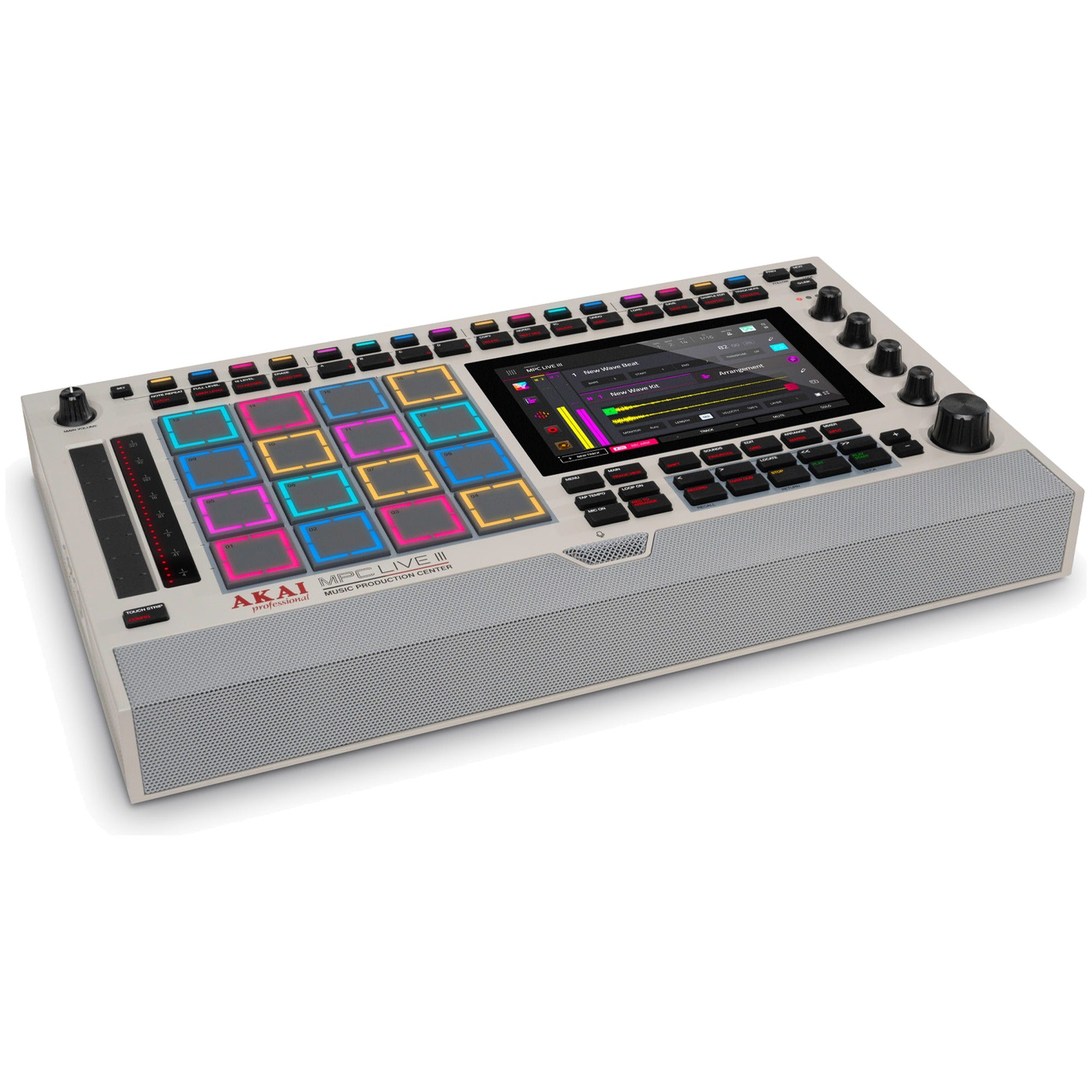
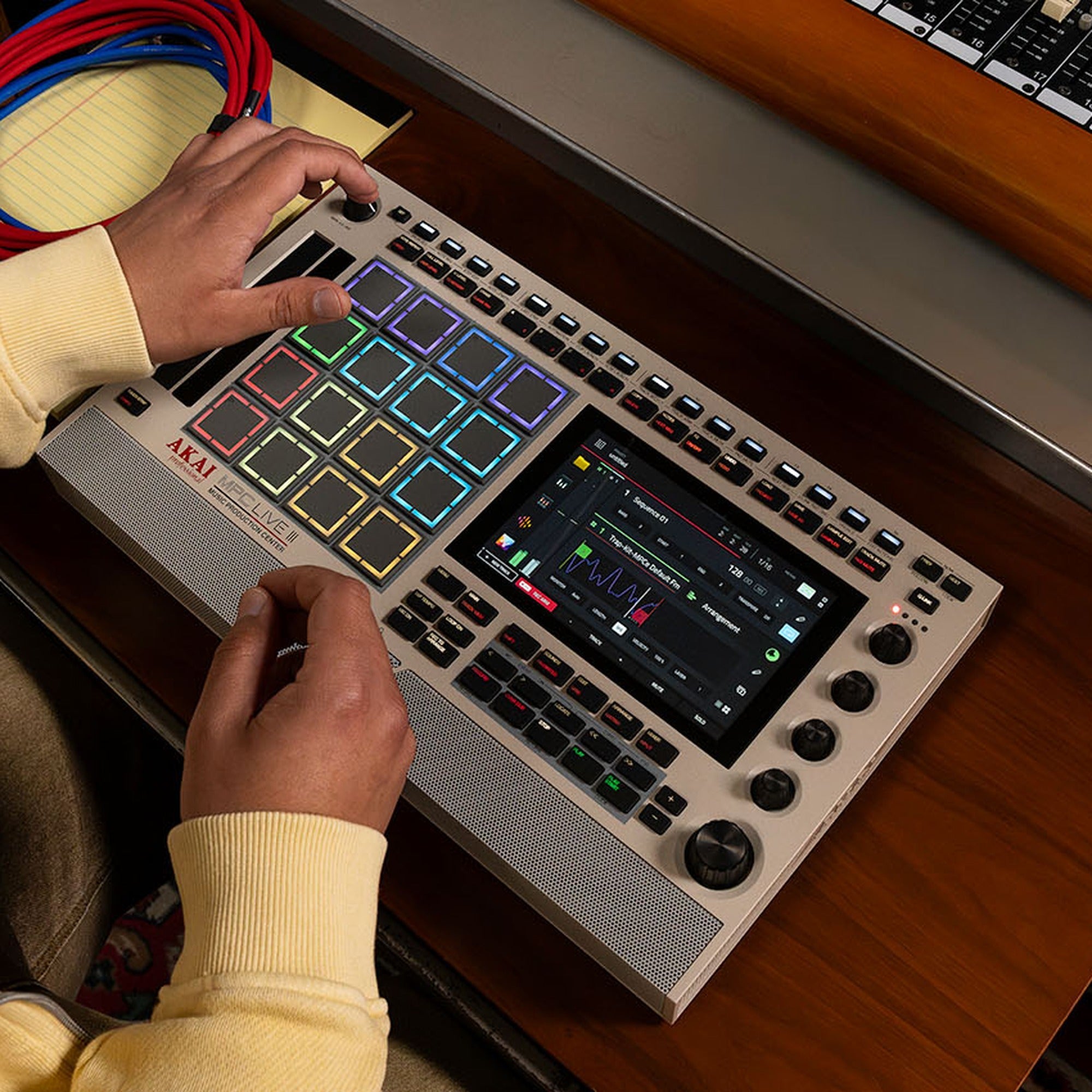
Akai pointed the MPC Live III at the opposite idea. Speakers, a mic, and a 5-hour battery are built in, so the whole studio is the one box on your lap. The Retro edition takes that machine and drops it into the colourway of the original late-80s MPCs, the ones that built sampling culture in the first place.
There's no price premium for the nostalgia. The Retro costs €1,649.99, the same as the standard III. You're picking a finish, not paying for one.
Key Features & Benefits
- A studio that needs nothing else. Built-in stereo speakers, an onboard condenser mic, and a rechargeable battery rated up to 5 hours mean you can sketch, sample, and arrange a full track on a train or a couch. Plug nothing in, open nothing on a screen.
- 4x the muscle of the Live II. The Gen 2 8-core processor runs 256-voice polyphony, 8 GB of RAM, and up to 32 plugin instances across 16 audio tracks. That's the headroom that lets the standalone workflow actually replace a laptop instead of gently apologising for not being one.
- 16 MPCe pads with 3D sensing. The RGB pads read velocity, pressure, and X/Y movement, so finger drumming carries expression a grid of triggers can't. Sample blending and dynamic note repeats live under the same pads.
- Clip launching, on the hardware. The new Clip Matrix brings Ableton-style loop launching and arrangement to the touchscreen, with follow actions, row launch, and snapshots. You can build and perform a song without ever opening a DAW.
- Stem separation that runs on the box. Pro Stems splits a finished track into drums, bass, vocals, and the rest, right on the device, so you can pull an acapella or an isolated break out of a record without a desktop tool.
- Connectivity for a real rig. 2 XLR/TRS combo inputs with mic preamps, 6 line outputs, 8 CV/gate outputs for modular, dual 5-pin MIDI, and USB-C carrying 24 channels of audio and 32 of MIDI. Wi-Fi, Bluetooth, and Ableton Link round it out.
- The 1988 livery. The Retro finish is the whole reason this version exists: the same internals as the standard III, in the colours of the machines that started it.

Real Reactions
"This is a truly go-anywhere production box that's determined to keep you away from a laptop at all costs." MusicRadar
"...there's little doubt in my mind that the MPC Live III is the best standalone DAW-in-a-box on the market right now." MusicRadar
"If price is no object, the Live III might be the most complete standalone groovebox yet, but you'll need to invest more than money — unlocking its full potential requires significant time and patience too." MusicTech (8/10)
The reviews and the pitch line up, which doesn't always happen. The hardware is the most capable standalone MPC yet, and the people who actually live in it call it the best laptop-free box you can buy. The catch is honest and worth repeating: the power is real, but so is the learning curve. You buy into a workflow, not just a unit.
How It Compares
| Akai MPC Live III Retro | NI Maschine+ | Akai MPC One+ | |
|---|---|---|---|
| Standalone, no computer | Yes | Yes | Yes |
| Built-in battery | Yes, up to 5 h | No | No |
| Built-in speakers + mic | Yes | No | No |
| Touchscreen | 7-inch multi-touch | No (dual displays) | 7-inch |
| Processor / RAM | 8-core Gen 2 / 8 GB | quad-core / 4 GB | quad-core / 2 GB |
| Onboard storage | 128 GB | 32 GB + SD | 16 GB |
| Clip launching + stem separation | Yes | No | No |
| Price | €1,649.99 | ~€1,399 | ~€749 |
Competitor figures are indicative, pulled from manufacturer specs as of May 2026. Data team to confirm against current listings before publish.
The split is clean. The Maschine+ is the natural rival if you live in Native Instruments' world, but with no battery, no speakers, and no touchscreen it stays tethered to a desk. The MPC One+ gets you into the same OS for less than half the price, though you give up the battery, the speakers, the storage, and most of the power. The Live III is the one that needs nothing plugged in to make a finished track, and that's the lane it owns.

Who It's For
- The make-it-anywhere producer. Beats on the bus, a hook in a hotel, an arrangement on the couch. If your best ideas don't wait for you to reach a desk, the speakers-plus-mic-plus-battery combo is the point.
- The committed MPC user. If you already think in pads and the MPC sequencer, this is the most powerful version of that workflow, with clip launching and stems added on top.
- The collector who'll use it. The 1988 livery is for the people who grew up on those machines, or wish they had. You're getting current-gen internals, not a reissue of old hardware.
- The modular and live crowd. 8 CV/gate outs, Ableton Link, and the Clip Matrix make it a capable brain for a hardware setup or a stage rig.
Who should look elsewhere: if you want a big screen and maximum flexibility, a laptop with an interface and a controller does more for the money. If you're on a tighter budget, the MPC One+ runs the same software for around €749. And if the retro finish means nothing to you, the standard MPC Live III is the identical machine at the same price, so pick whichever colour you'd rather look at for the next decade.

Pros & Cons
✅ Pros
- Fully self-contained: speakers, mic, and a 5-hour battery built in
- 8-core Gen 2 power, 8 GB RAM, 128 GB onboard, 256-voice polyphony
- Clip launching and onboard stem separation, both new to the line
- Expressive MPCe 3D pads, deep CV and MIDI connectivity
- The original 1988 AKAI look, at no premium over the standard III
⚠️ Cons
- €1,649.99 is real money; a laptop, interface, and controller can cost less and flex more
- The MPC3 OS has a learning curve, and the busier control surface takes time to navigate
- 3.9 kg, and the battery is built in, so "portable" means a chunky box you can't re-cell yourself
- The pads' X/Y data doesn't map to synth plugin parameters yet

Where to Buy
The Akai MPC Live III Retro is €1,649.99 at Soundium, on pre-order now in the vintage AKAI colourway.
Pre-order the Akai MPC Live III Retro from Soundium →
Free shipping over the standard threshold, 3 interest-free installments of about €550, secure checkout, and a 30-day money-back window if it isn't for you. Every unit ships with a 3-year warranty through Soundium.
Final Thoughts
Pick your beatmaking setup by what you actually want from it. Want the most screen and flexibility for the money? A laptop rig still wins. Want the cheapest way into the MPC workflow? The One+. Want one box that needs nothing else to finish a track, in the colours that started the whole thing? The MPC Live III Retro is the smart call, and at €1,649.99 it costs exactly what the plain version does.
Still Deciding?
Not sure whether a standalone box or a laptop rig fits how you actually work? Talk to the Soundium team and we'll point you to the setup that matches your room, your stage, and your budget.